Plain answers — from the basics to "why should I care?"
Start anywhere. The first questions cover the basics — what a PUD is, what fixed wireless is, what the District decided. The rest are the ones people actually ask out loud: my internet is fine, why should I care? I’m well off — why does this matter to me? I love Starlink, why would I ever need this? and my local provider burned me — why would I want more of that? Every answer links to the evidence behind it.
Start here
The basics, in plain language
What is this site about — in one sentence?
Okanogan County's public utility district (PUD) quietly paused investment in the rural fixed-wireless broadband network that connects thousands of homes, farms, and small businesses — and we're asking the elected Board to put that decision through an open, public review before the network is allowed to age out. Start on the home page →
What's a PUD, and why does it run an internet network?
A Public Utility District is a locally-owned, non-profit public utility run by an elected Board of Commissioners. Washington's voters created PUDs by ballot initiative in 1930 for a reason that should sound familiar: private power companies were charging rural communities whatever they wanted, and public ownership was how people took back control of their rates — a utility run at cost, by the community, not for a distant company's profit. (Reaching places those companies wouldn't serve was part of it too.) Broadband is the same idea for this century: the Okanogan PUD runs a fiber backbone with a wireless last mile and sells access wholesale to local private internet providers, keeping a public, cost-based network under local control so no single company sets the price. See the history →
What's the difference between the PUD (a "wholesale" provider) and an RSP?
The PUD is the wholesale provider — which means it owns and runs the network itself. The towers, radios, and fiber backbone are the District's own infrastructure, built and maintained by its own crews, and it sells capacity on that network at a cost-based rate rather than selling internet to you directly. An RSP — a Retail Service Provider — is one of the local companies (Highland, NCI, Will Connect, CommunityNET and others) that resells service over the District's network: they sign you up, handle your installation, send your bill, answer your support calls, and set your retail price — but the network they're selling over is operated by the PUD, not by them. So the network is public and publicly run; the company you actually pay is a local business selling on it. That two-layer setup — one publicly operated network, many competing retail sellers on top — is called open access, and it's the thing that keeps prices honest. Why open access protects your rates →
Why does this site count "RSP subscribers" instead of households?
Because that's what the District's records actually track. The PUD sells wholesale to the RSPs and counts each RSP's subscriber accounts on its network — not households directly. That distinction matters when you read the numbers: if one RSP's account count falls, it doesn't automatically mean those homes left the county or lost service. A reseller that also runs its own towers (as NCI does) can move customers onto its own network — so its PUD account count drops while the customers stay put. That's why a decline in one reseller's subscriber accounts on the network is a reseller-level change, not automatically a loss of demand for the public network. See the decline broken down by provider →
What's "fixed wireless," and how is it different from fiber or Starlink?
Fixed wireless beams internet from a tower to a small antenna on your house — no trench to dig, no satellite overhead. Fiber is faster but costs tens to hundreds of thousands of dollars per home to reach a remote ranch; satellite (Starlink) reaches anywhere but is owned by one out-of-state company. Fixed wireless is the middle path that covers rugged ground fiber can't afford to reach, at a price rural families can actually pay. Check what serves your address →
What did the PUD actually decide?
In May 2026 the District chose to stop investing in the wireless network — declining a roughly $1.2 million upgrade that would replace its end-of-life radios with modern equipment — while moving to walk away from tens of millions in federal broadband grants. The existing gear still runs, but without the refresh it slowly falls behind. Read the full case →
The PUD says it's still investing in broadband and building fiber — isn't the network in good hands?
It's true — and we're glad of it. The District is investing in fiber: the Conconully build and a major upgrade to its high-capacity backbone. We support that work. But “investing in broadband” isn't the same as investing in the rural wireless network — and the wireless network is the specific piece on pause. The roughly 2,700 households on wireless don't get fiber to Conconully; for them, the only modernization on the table is the ~$1.2 million wireless upgrade — and budgeted reinvestment in that network had already fallen about 92%. Here's the detail that makes it clearer, not murkier: a stronger backbone is exactly the groundwork that higher wireless speeds depend on — so the District has started the job; the wireless radios are the next step, and that's the step on pause. The District's own engineers had already designed that wireless replacement. So “we're still investing” is true — it just doesn't yet reach the rural majority this campaign is about. What the Conconully project is →
What is this campaign actually asking for?
Not a particular budget, and not anyone's job. We're asking the elected Board of Commissioners to give a decision of this size a public review — to put its analysis on the record and let ratepayers weigh in before the network is allowed to decline. A choice this consequential shouldn't be made quietly. How to add your voice →
Why this affects me
Why should I care?
My internet is already fine. Why should this matter to me?
Because a public, at-cost network is the thing that keeps prices honest for everyone — including you. Where the local option disappears, rural customers are left with a single satellite provider that prices by how few choices you have. The network is less a service you buy than a yardstick that disciplines what everyone else can charge. Why the towers protect your rates →
I'm doing fine financially. Why should I care how this affects lower-income or rural families?
Three honest reasons, none of them charity. First, your own interest: the same price-discipline that protects them protects you — and keeping a connection affordable underpins home values, local businesses, and the $363 million agricultural economy the whole place rides on. Second, the things your money can't buy locally: a staffed clinic, a decent school, an EMT ten minutes out, a contractor who calls back — those are made of working families being able to live here, and an affordable connection is now part of what keeps them. You can buy yourself a great internet connection. You can't buy yourself a functioning county to use it in. Third, it's already yours: you're a part-owner of this network. Nobody's asking you for a subsidy; an asset you own is being allowed to decay. Meet the ratepayer →
I live in town, not out in the county. Does this even touch me?
Yes. The towns are where fiber and funded builds concentrate; the rural majority — about 62% of the county — is who the wireless network serves, and that's the county's farms, its workforce, and its tax base. A town economy doesn't float free of the county around it. And the price-stability point applies in town too: fewer local options anywhere means more pricing power for whoever's left. See it on the maps →
Will this raise my rates?
The wireless line is self-supporting — it earns about $1.1 million a year, and the telecom segment it belongs to runs an audited surplus, so the upgrade is paid from the network's own revenue, not from electric rates or a new charge. The bigger rate risk runs the other way: letting the public option disappear hands the county to a single satellite monopoly free to charge what it likes. See the audited finances →
Isn't this just subsidizing a handful of people out in the boonies?
No — on two counts. It's not a subsidy (the network pays its own way and turns a profit), and it's not a handful: the wireless layer serves roughly 2,700 customer connections, and its footprint reaches about 77% of the county — the dispersed rural majority, not a fringe. The towns get fiber; nearly everyone else gets wireless or nothing. See who's inside the footprint →
Who the wireless network actually serves
The towns get fiber; the dispersed rural majority gets wireless or nothing — and it pays its own way. Not a subsidy.
If you've been burned
I had terrible service from a local provider. Why would I want more of that?
My experience with local wireless was awful — slow speeds, outages, waiting on hold. Are you telling me I imagined it?
No. The bad experiences are real, and we're not going to argue with a single one of them. What we can tell you is what you were actually experiencing — because it's documented. The radios serving most wireless customers were bought around 2010 and are now six to nine years past every published service life for this class of equipment (federal guidelines say 7–9 years; the District's own planning documents say 10). They're sold at 3–20 Mbps because that's what 2010 hardware delivers, and the District's own internal memo calls the network "severely congested with no possibility for expansion." Meanwhile budgeted reinvestment fell about 92%, and new installations went from 229 a year to 2. A 2010 radio in 2026 delivers a 2010 experience — no matter how hard the person answering the phone works. Your frustration isn't evidence the network should be allowed to die; it's what the decision to stop investing in it feels like from the customer's side of the bill. Where the investment went →
What "aging out" looks like from inside a customer's house
Sources: District budgets and internal memo (public records); federal equipment-life guidelines. The service got frustrating because the investment stopped — not the other way around.
Most of my horror stories are about NCI specifically. Doesn't that prove the "local provider" model doesn't work?
It's worth looking at what actually changed at NCI — because it points the opposite way. NCI was founded here in 1997 and was genuinely local for 25 years. In 2022–23 it was sold to an out-of-state investment rollup — Core Fiber Partners, which owns seven internet providers across five states, has been consolidating billing and phone support onto shared out-of-area platforms, and is rebranding NCI as "Core Fiber." The outages and support problems that followed aren't something we have to allege: NCI's own CEO told customers in December 2025 that he takes "ownership of these issues" and apologized, after a town hall drawn largely from its wireless service areas. (In fairness: NCI both resells the public network and runs towers of its own, so no outsider can sort which outage happened on which system — and we won't pretend to.) But notice what your bad year actually coincided with: a local company becoming an absentee-owned one. That's not a failure of the local model — it's a preview of what the county gets everywhere if the locally-accountable layer is allowed to age out. What customers say about the buyout →
Fine — the equipment was old and one company got bought. Why would new radios actually fix any of it?
Because the record shows the part that wasn't broken. Set NCI aside and look at the other local providers, on the same aging network: through five and a half years of 20 Mbps radios, a competitor advertising 600 Mbps on the same ridges, and Starlink overhead, their customer base held nearly steady — down about 5% in total, with one provider growing 63%. Thousands of people stayed, at a thirty-fold speed handicap, because a local person who answers the phone and shows up is worth that much. That's the piece no company can ship from out of state. The upgrade doesn't have to create the local providers' advantage — it just removes their handicap: the planned package is 250/50 Mbps (typical real-world 300–450 on this gear) with ~10 ms ping — ten to a hundred times the speeds the 2010 radios are sold at, delivered by the same people whose service already kept customers loyal when the equipment was the worst thing about it. What the upgrade delivers →
Loyalty at a thirty-fold handicap, 2021→2026
Outcome over 5.5 years, from the District's own billing records: the other local providers' base slipped just −5% (one grew +63%). People were staying for the service. The upgrade removes the speed handicap; the service stays.
Why not just fiber
Why not just build fiber to everyone?
Why not just run fiber to every home instead of upgrading wireless?
Because out here it costs about 9× more per home — roughly $40,000 vs. ~$4,300 on flat ground — driven by the rugged terrain and ~8-people-per-square-mile density. The county's own feasibility study and the federal BEAD program both conclude fiber can't economically reach the dispersed rural majority, which is why most of rural Washington is being funded for wireless, not fiber. The District is building fiber where it pencils (the towns); the wireless is what reaches everyone else. The full fiber-cost math →
Cost to run fiber, per home
Cost per home passed. Okanogan = the District’s own $30.2M USDA ReConnect award ÷ 745 homes; Grant = a countywide build (ILSR). About 9× more to reach a home here.
Isn't fiber the future? Why pour money into "old" wireless?
Fiber is the best technology where it reaches — and the District is building it to the towns. But modern fixed wireless isn't "old": the upgrade delivers 250+ Mbps, and Washington's largest-ever broadband award just went to a fixed-wireless provider. The money is flowing toward wireless precisely because of the rural terrain Okanogan has. Why the funding favors wireless →
How the new system works
The technology, in plain terms
What is "next-generation fixed wireless," in plain terms?
It's the class of equipment the District chose for the upgrade (the platform is Tarana). The big difference from older wireless: it puts a smart, steerable antenna array at both ends — the tower and the home — and it recombines signal that has bounced off and diffracted around obstacles instead of needing a clean line of sight. That's a real, independently-confirmed step up from the Cambium/Ubiquiti gear most rural networks run. The full breakdown →
Does it really work without line of sight?
Mostly yes — with one honest limit. It reaches around ridges and through moderate tree cover that stops the old radios, which is exactly Okanogan's problem. What it can't do is beam through a granite mountain or a deep, dense forest — no radio can, and we won't claim otherwise. You can see that exact trade-off on the 3D terrain map: the new gear lights up forested slopes and shadowed pockets the old line-of-sight gear leaves dark, but true terrain shadow still blocks both.
How fast is it, really?
The District's planned package is 250 / 50 Mbps — up from the 3–20 Mbps most customers are sold today — and its own field test from Jackass Butte recorded links from 243 up to 946 Mbps (median ~720). Be careful with the headline "gigabit" figures, though: those are best-case single links. Independent monitoring of tens of thousands of these radios shows a typical real-world download around 300–450 Mbps. Still many times today's speeds — just not "gigabit to every home." The District's field-test data →
Download speed, Mbps
Independent monitoring of tens of thousands of these radios shows a typical real-world ~300–450 Mbps — many times today’s speeds, not “gigabit to every home.”
If a competitor (NCI) puts the same system on the same mountains, won't they interfere?
A fair question, and the honest answer is: in principle any two wireless systems sharing spectrum on one site can interfere — but in practice it's routine, manageable, and already working here. Multiple operators share towers across the country every day; it's engineered around with channel planning and time-synchronization. NCI has co-located on these exact ridges (Eder, Coleman, Jackass Butte, Tonasket) for years — advertising 600/50 Mbps on Eder while the PUD network sold 20 — and the PUD network still held at peak levels through late 2023, at a thirty-fold speed handicap. The upgrade removes that handicap; if both ran the same gear, they'd coexist better, not worse, because matched equipment synchronizes cleanly. The one real condition is coordination — which is exactly what a cooperative public utility can lead. The full, sourced answer →
Is this "future-proof"? Will it last?
We won't oversell it: it isn't fiber and it isn't forever. Even the independent, wireless-friendly analyses call it complementary and transitional — the best answer where fiber is uneconomic, not a permanent equal. Wireless gear cycles faster than fiber, and there's an ongoing per-radio licensing cost. The honest pitch is "the right tool for this county now," and a public, professionally-run network is the best way to keep upgrading it on a sane schedule.
Why not just keep the current wireless running as-is?
Because the District's own internal memo says the current radios are "no longer keeping up with demand" and "all areas are severely congested with no possibility for expansion" — they're end-of-life. "Keep it as-is" really means "let it slowly fail." The upgrade reuses the same seven towers and the same backhaul — no new towers, no new licenses — for about $1.2 million. What the upgrade actually is →
When the fire comes
Wildfire, emergencies & resilience
What happens to the internet during a wildfire?
It has failed before — in fires where people died. In the 2020 Cold Springs Fire (which killed a one-year-old child), the network burned and 911 was rerouted out of the county for about 12 hours; in the 2014 Carlton Complex, 911, internet, and phones were down for nearly five days. In a county that holds the state's largest-fire records, the connection isn't a convenience — it's whether help arrives. When the fire comes →
When the network went down in a fire
911 rerouted out of the county for ~12 hours in 2020 (a fire that killed a one-year-old child); 911, internet, and phones down for nearly five days in 2014.
If everything goes down in a fire anyway, why does it matter who owns the network?
Because a network the county owns can be hardened, restored, and answered for by people who live here — and the PUD's own wildfire plan already treats it as emergency infrastructure (its fiber even runs the power grid's communications). A satellite you depend on still needs local power and a clear sky, and it answers to a company far away. Local ownership is what lets the county invest in resilience and recovery. Why local control matters in a disaster →
Isn't Starlink actually more reliable when disaster strikes?
Starlink is a useful backup, but it needs power (~50–75 watts) and a clear view of the sky too — and the PUD's own plan notes areas where even satellite phones don't work. The real lesson is that resilience comes from layers: a local network you control plus satellite behind it, so no single failure leaves the county dark. Letting the local layer go does the opposite — it makes one fragile, distant system your only option. The fragility of betting on satellite alone →
The Starlink questions
I love Starlink. Why would I ever need this?
I have Starlink and it's great. Why would I need a public network?
Keep it — Starlink is a genuinely good backup, and nobody's taking it away. But three things it will never be: local, at-cost, or accountable to you. It's one company's to price, throttle, or switch off, and every dollar leaves the county. The public network is the competition that keeps even Starlink honest here — remove it and you're negotiating with a single global provider that prices by how few options you have. The full Starlink answer →
Won't Starlink just keep getting better and make this pointless?
It will get better — and that's an argument for keeping it as the backup, not for surrendering the network you own. A faster rental is still a rental: newer satellites don't make it local, at-cost, or accountable, and the more capable it gets, the more a county that leans on it depends on one company's prices and goodwill. Why "Starlink will improve" cuts the other way →
Isn't satellite simpler than maintaining a bunch of towers?
Simpler for the District, maybe — but "simpler" isn't free. Hand the county to satellite and you trade a locally-owned asset that earns money and disciplines prices for a monthly bill to an out-of-state company, with no local board, no public records, and no at-cost rate. The towers, fiber, and rights-of-way are already built and largely paid for; only the swappable radios need refreshing. Why "tech changes" isn't a reason to walk away →
People say Starlink could "fall apart" — isn't that just fearmongering?
It's structural, not speculative. Starlink's satellites last about five years, and one or two burn up every single day — so roughly 2,000 must be launched every year just to keep the network from shrinking. It's the only major broadband system on Earth that degrades without a constant stream of rocket launches from one company, and a moderate solar storm already destroyed 38 of 49 satellites in 2022. None of that makes it bad — it makes it a backup, not a foundation. The structural fragility, in full →
Why it’s a backup, not a foundation
No other major broadband system on Earth degrades without a constant stream of rocket launches from one company. Sources: SpaceX/FCC filings; the Feb 2022 geomagnetic-storm loss.
Why does it matter that one company runs it?
Because it isn't a regulated utility: no rate board, no obligation to serve, terms it can change at will, and its own contract says the service is "not… a safety-of-life service." One person holds roughly 80% of the voting control — and in 2022 that one person geofenced Starlink off in a war zone and declined an urgent request to switch it on. If a nation at war has that little say, a rural county has even less. One company, one person, no accountability →
In a power outage, doesn't Starlink burn through batteries and fuel faster?
It does — and that's an argument for the tower. A Starlink dish runs continuously at about 50–75 watts — and roughly double that in winter, when it heats itself to melt off snow — so on a solar battery or a generator during an outage, a dish at every home drains stored power and fuel fast. The more efficient approach is to prioritize backup power on the shared tower: keep a handful of tower sites running and many homes stay connected, instead of every household independently powering its own dish through the storm. The satellites may be in the sky, but the energy to use them is spent on the ground, at every single house. The outage-energy math →
If I just get Starlink, who keeps it working ten or fifteen years from now?
You do — and that's the part the pitch skips. A satellite kit is a product you self-maintain: over the years the power supply ages, the cable weathers, the router goes obsolete, a new generation stops fitting the old dish — and each of those is yours to diagnose, buy a part for, and climb the roof to fix. Starlink's warranty is 12 months, and its own terms say the service is "not… a mission-critical or safety-of-life service." Across roughly 3,000 rural connections, even a 1% yearly hiccup is about 30 households a year left to sort it out alone. A local network is the opposite: infrastructure someone is responsible for — standardized gear, spare parts on the shelf, and a technician who drives to your address. That's the difference between renting a kit and owning a service. Who keeps the fleet alive over fifteen years →
The money
Can they afford it — and is it worth it?
Can the PUD actually afford this?
Easily. The telecom segment is a strong earner whose audited net worth more than doubled — from $4.86 million in 2019 to $10.5 million in 2025 — and it runs an operating surplus nearly every year. The roughly $1.2 million upgrade is well within what the network itself generates; affordability was never the obstacle. See the audited numbers →
Telecom segment net worth (audited)
Net position of the telecom segment — more than doubled in six years. Source: Washington State Auditor financial statements. The ~$1.2M upgrade is a fraction of that.
$1.2 million sounds like a lot. Is it?
In context, it's modest. The same District moved to walk away from roughly $50 million in federal broadband grants — a confirmed $19.7 million BEAD loss plus a $30.2 million fiber grant it moved to rescind — while declining this $1.2 million wireless refresh. It's also spending about $4.3 million to wire 367 homes in one town. The upgrade serves thousands for a fraction of that. Follow the investment →
Is the network a money pit?
The opposite. Wireless brings in about $1.1 million a year, the telecom segment runs an audited surplus, and the per-tower math pays the upgrade back well within the equipment's life. This isn't a struggling venture being propped up — it's a profitable one being under-reinvested. See the per-tower payback →
Technology keeps changing — won't they just have to spend again in a few years?
Every owner refreshes radios on a cycle — Starlink and every private wireless provider included; it's the cost of being in this business. But the durable assets — towers, fiber backhaul, rights-of-way — don't go obsolete; only the swappable electronics do. "We'll have to keep it current" is an argument for stewardship, not for letting it decay. The full answer →
If the money was there, where did it actually go?
We mapped every budgeted dollar. Inside a flat ~$3.25 million a year, operating costs rose about 41% while investment was cut about 51% — and a surplus was banked every year. The money wasn't spent down; it was steadily redirected to overhead and fiber, away from the wireless. Follow the money →
Inside a flat ~$3.25M/yr telecom budget, 2019→2025
The total budget barely moved — but the mix shifted: more to overhead, less to building, with a surplus banked every year. Source: District budgets (public records).
Why didn't the PUD just save up to upgrade the wireless all along?
Honestly, we don't fully know why — that part the District hasn't explained. But where the money went is no mystery; it's in the District's own budgets. The records make the pattern hard to miss: budgeted reinvestment in the wireless network fell about 92% — from roughly $330,000 a year in 2021 to about $26,000 in 2026 — and the subscriber base, which had been growing, turned and began falling right as that investment hit the floor.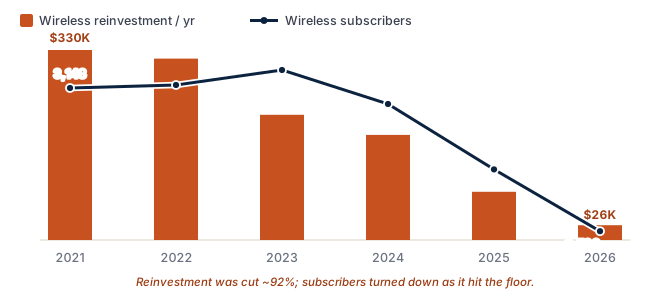 Where did it go? Into the District's fiber program and overhead — its own budgets show capital tilting toward fiber distribution while the wireless line fell to near zero, with a surplus set aside each year. We're not second-guessing the fiber work: the District is investing about $4.3M in fiber to Conconully, while the ~$1.2M wireless upgrade is not in the 2026 budget. Both are worth doing. We’re not alleging bad faith — just asking the open question the records raise: the wireless network pays its own way and serves the rural majority, so what would it take to fund its upgrade too? The Board agreed to a workshop; we’re asking it to follow through. Follow the money → · What happened at the June 22 meeting →
Why invest in a network that's losing about 30 customers a month?
Because the decline is the symptom the upgrade cures — not a reason to quit. The network is shrinking for two fixable reasons: it's full (the District's own memo calls it "severely congested with no possibility for expansion," so it literally can't take new customers), and a single out-of-area consolidator accounts for about half the entire decline. You don't turn a stagnating asset around by starving it further — you upgrade it so it can take customers again and reach homes it can't serve today. Walking away just locks the decline in. See the subscriber and churn data →
Is public broadband even a good idea?
The "government shouldn't do this" questions
Shouldn't the government stay out of competing with private business?
This is the private-friendly model. The District doesn't sell to you directly — it sells wholesale to seven or eight local private companies that compete with each other over its network. That's more private competition than most rural counties have. Walking away doesn't free a market; it hands the county to one out-of-state satellite firm. Even the leading skeptic's own test says build it →
Haven't a lot of city broadband projects failed?
The famous failures were all the same animal — borrowing heavily to build a brand-new retail system from scratch (or, in one case, outright fraud). Okanogan's network is the opposite: already built, already profitable, open-access wholesale, making a routine upgrade. You can't default on a network that already works — you can only abandon it. Every failure, answered →
If it could make money, wouldn't a private company have built it?
No private company did — which is exactly why a public utility should. Where the returns don't pencil out for a firm chasing profit, a public utility with a far lower cost of capital and a mandate to serve is the right owner. That's not a loophole; it's the entire reason PUDs exist. Answering the critics →
Is Okanogan the only PUD doing this, or are others pausing too?
Okanogan is the outlier. Across Washington, peer public utilities are expanding broadband — and the one most like Okanogan (Pend Oreille: rural, mountainous, stimulus-built, running fiber and wireless) kept its wireless. Several peers run broadband at a loss because reaching rural people is the mission; Okanogan's actually turns a profit, yet it's the one stepping back. How Okanogan compares →
Isn't "public broadband" just government overreach?
Out here it's the opposite of overreach — it's self-reliance. This isn't a government program done to you; it's infrastructure the county owns and controls, governed by commissioners you elect, built by neighbors when outside companies wouldn't show up — the same independent spirit that strung the county's power lines. The alternative isn't "the free market"; it's depending on a single distant satellite monopoly. Rural self-reliance →
Hasn't technology moved on — isn't a county wireless network kind of antiquated?
Just the opposite. The upgrade isn't old tech — it's next-generation fixed wireless, the same class of gear Washington's broadband program is funding across rural counties precisely because it fits this terrain. Demand for bandwidth climbs every year, not falls. And the model — locally owned, at-cost, accountable — only grows more valuable as broadband consolidates into a few distant companies. PUDs were created a century ago to bring electricity to rural areas private firms wouldn't serve; broadband is the same job for this century. What the upgrade actually is →
Surely the PUD has a good reason for pausing — what is it?
Fair question, and we're not assuming bad faith. But the District's public explanation has been limited — a May 2026 letter pausing wholesale wireless investment, without a detailed public cost-benefit case. There may be legitimate reasons: capital caution, a wish to focus on fiber, or wholesale-market concerns. The trouble is that its own internal staff documents argued for the upgrade, and the audited numbers show it's affordable — so the case for reversing course isn't visible in the public record. That's exactly why we're asking for an open, public review: so whatever the reasons are, they're laid out with the numbers before an asset this important is allowed to age out. Ask the Board for a public review →
What you can do
Acting on it — and checking our work
I'm convinced. What can I actually do?
Two minutes: add your name and send the letter asking the elected Board to give this decision a public review, then forward this site to a neighbor. The Board answers to its ratepayers — your voice on the record is the entire point. Take action →
How do I know these numbers are real?
Every figure is drawn from primary sources — the District's audited financial statements (Washington State Auditor) and its own monthly telecom billing records obtained by public-records request — and we flag confidence where the data is partial. If a claim would be convenient but isn't fully supported, we don't make it. See the sources and documents →
Who is behind this site?
It's an independent effort by Okanogan County ratepayers — not affiliated with the PUD, and technology-neutral: we're not against fiber or satellite, we're for keeping a locally-owned option in the mix and giving a big decision a public hearing. Follow the latest →
Still have a question?
These pages go deeper on the points the questions above only touch.
Answering the critics
Every "public broadband fails" argument, taken seriously and answered.
Read the rebuttals →Why it protects your rates
The network as a price hedge — the yardstick that keeps everyone honest.
See the argument →Add your voice
Ask the elected Board to give this decision a public review.
Take action →